Breathe
This site is not in a hurry
ANGKOR
The Reason We Began — Angkor, the Khmer, and a House Built in Siem Reap
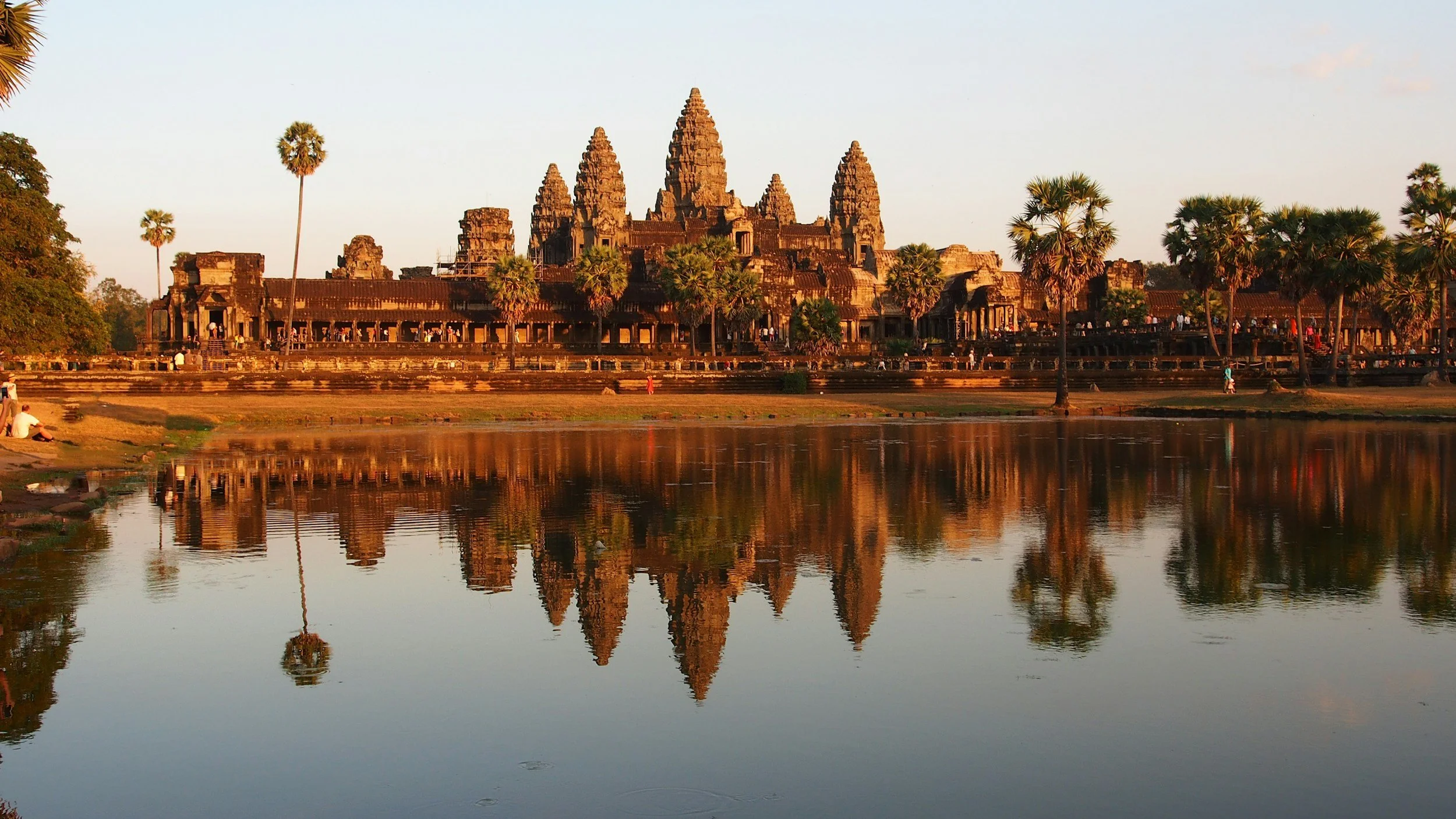
We began at the foot of a temple.
Khmere is a fragrance and wellness house rooted in Cambodia. This is why.
In the early twelfth century, while Europe was still building its first cathedrals in stone, Suryavarman II laid the foundation of Angkor Wat. It took something close to thirty years to raise — five million tonnes of sandstone, floated down canals from the Kulen hills, carved by hands whose names no record has kept. It was conceived as a temple to Vishnu and, in time, became a place of Buddhist devotion. It remains the largest religious monument on earth.
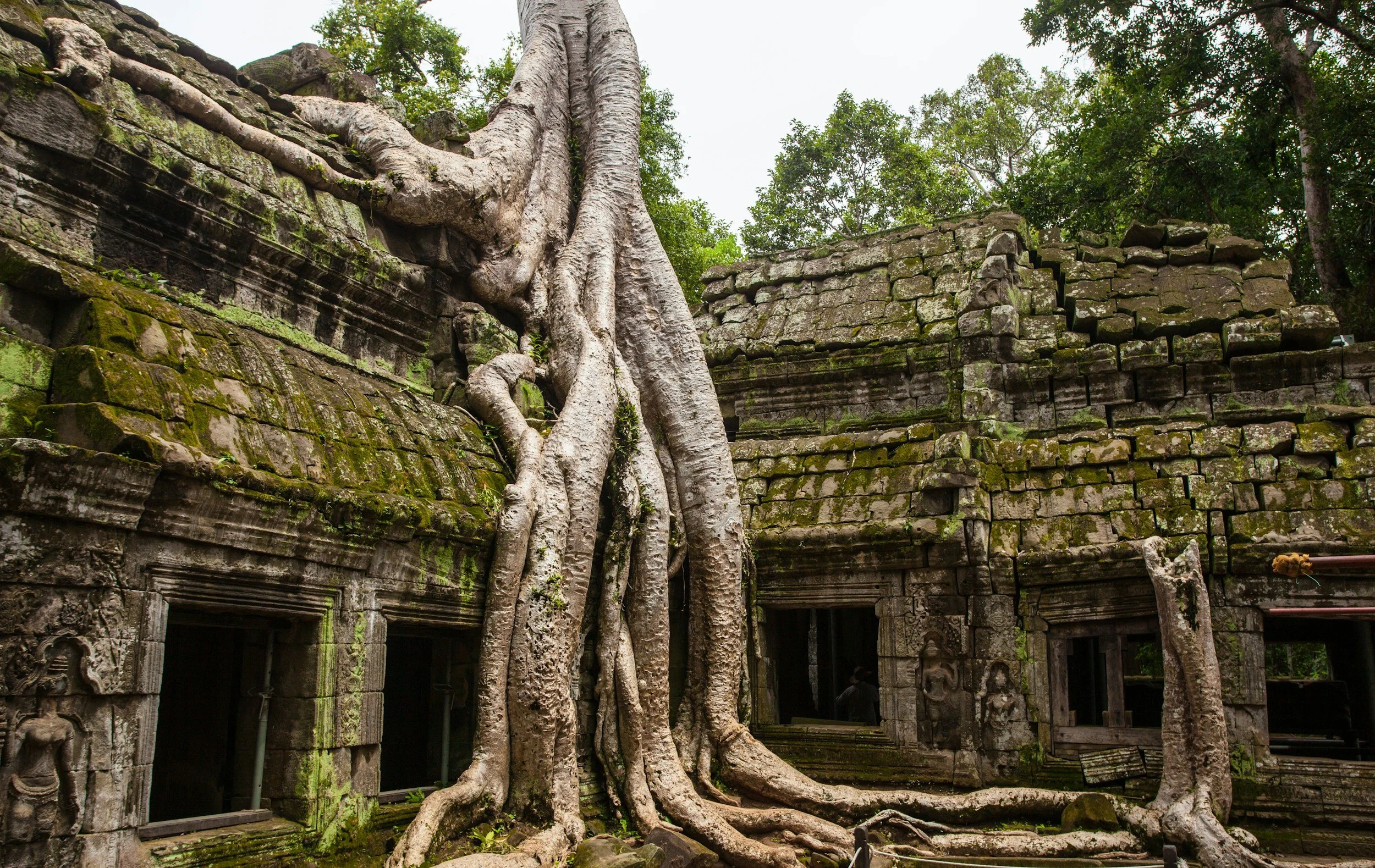
For centuries it slipped out of Western consciousness. The jungle moved in. Roots wrapped the towers. The court that built it migrated south. When a French naturalist stumbled into the ruins in 1860 and wrote of them in his journals, Europe convinced itself it had made a discovery. The Khmer had never forgotten. Monks had been walking those galleries the whole time.
What pulled us toward Angkor was not its scale. It was the question the site refuses to answer cleanly. How does a civilisation rise to this level of mastery — hydraulic engineering, astronomical alignment, lapidary carving — and then quietly fold itself back into the forest? The temples do not explain themselves. You walk them and you feel the silence working on you.
FRENCH INDOCHINA
A region the world romanticised, then misread.
The French called this stretch of Southeast Asia Indochine and turned it into a fantasy of dusk verandas, ceiling fans, and orchids. The fantasy is not entirely wrong — there is something genuinely cinematic about the light here in the hour before rain — but it skims the surface. The deeper Indochina is older than France's arrival and outlived its departure. It is a region that has absorbed Hindu cosmology, Theravada Buddhism, Chinese trade, Indian script, French masonry, and the heat of the monsoon, and metabolised all of it into something distinctly its own.
We were drawn here for the texture beneath the postcard. Lacquer work that takes six months a panel. Silk woven on looms unchanged in a thousand years. Pepper grown on vines tied to wooden posts in red Kampot soil. A botanical inventory — rumduol, mondulkiri honey, kampot pepper, ivy gourd, palm sugar — that the global fragrance and wellness industries have, astonishingly, barely touched.
THE KHMER
A people who outlasted everything sent against them.
The Khmer have been continuous on this land for the better part of two thousand years. They built Angkor. They survived the collapse of the empire that built it. They survived colonisation. In living memory, they survived a regime that murdered perhaps a quarter of their own population and tried to erase every record of who they were — burning libraries, executing teachers, breaking instruments. Almost everyone you meet over the age of fifty in this country is the descendant of someone who should not, by any rational accounting, have made it through.
What strikes you, when you live here, is not the trauma. It is the warmth. Cambodians carry themselves with a courtesy that has nothing to do with deference and everything to do with self-possession. They built Angkor. They know they built Angkor. Whatever history has done to them, that fact sits underneath.
Khmere is a vehicle for that pride. The work is done here, in Cambodian hands, with Cambodian raw materials, paid at a wage that reflects the skill involved. There is no other way to do this honestly.
SIEM REAP
The town we did not mean to stay in.
Siem Reap began as a service town for the temples — a place pilgrims passed through. It is still, in some ways, a place people pass through. They come for three days, see Angkor at sunrise, drink a tamarind cocktail on Pub Street, and fly out.
We meant to do the same.
What happened instead is that the town worked its way under our skin. The Siem Reap River, brown and slow, running through the centre. The Old Market at six in the morning, before the tourists wake — fish still flapping on banana leaves, monks in saffron walking the alms route, the smell of charcoal and lemongrass. The wats lit from inside at dusk. The motodops who remember your name after the second ride. The painters and silversmiths working out of open-fronted ateliers off the main road. The bicycle commute past rice paddies to a half-acre warehouse where, eventually, we built the workshop.
It is a town the right size for craft. Big enough to find every skill you need within a fifteen-kilometre radius. Small enough that the people doing the skilled work are people you know.
WHY KHMERE EXISTS
A house built where the materials are.
Most fragrance houses are headquartered in Grasse, Paris, or New York, and source their botanicals from somewhere else — usually here, or somewhere like here. The economics of that arrangement have not changed materially since the colonial period. The grower receives a fraction. The brand keeps the story.
Khmere inverts the geography. The house is in Siem Reap. The botanicals are grown, harvested, distilled, and finished within a few hours' drive of the workshop. The fragrance chemistry is documented and tested — GC-MS analysis, proper provenance trail — because we come from a forensic background and we do not know how to work any other way. The story is the same story you would tell about a Burgundy domaine or a single-estate coffee. It belongs to the place.
That is the whole proposition. Cambodian raw materials, Cambodian hands, the standards of a serious European house, and a temple older than the Notre-Dame quietly in the background of everything we do.
Our Philosophy
We believe wellbeing is an art—one cultivated through intention, knowledge, and refined experiences.
Every offering is thoughtfully designed for those who value craftsmanship, subtlety, and lasting impact. Learn More